

LED recessed lights can make a room feel brighter, cleaner, and more put-together without adding visual clutter. But the size you choose affects almost everything you will notice day to day. It affects how wide the light spreads, the number of fixtures you may need, the appearance of the ceiling, and whether the room feels cozy or overly bright. This buying guide walks you through the fundamental differences between 4-inch and 6-inch options using clear, practical examples. You will get a side-by-side table, room-by-room guidance, spacing tips, and quick FAQs so you can buy with confidence.
Should I choose 4-inch or 6-inch LED recessed lights
If you want a fast starting point, consider the most straightforward approach: whether to select 4-inch or 6-inch LED recessed lights.
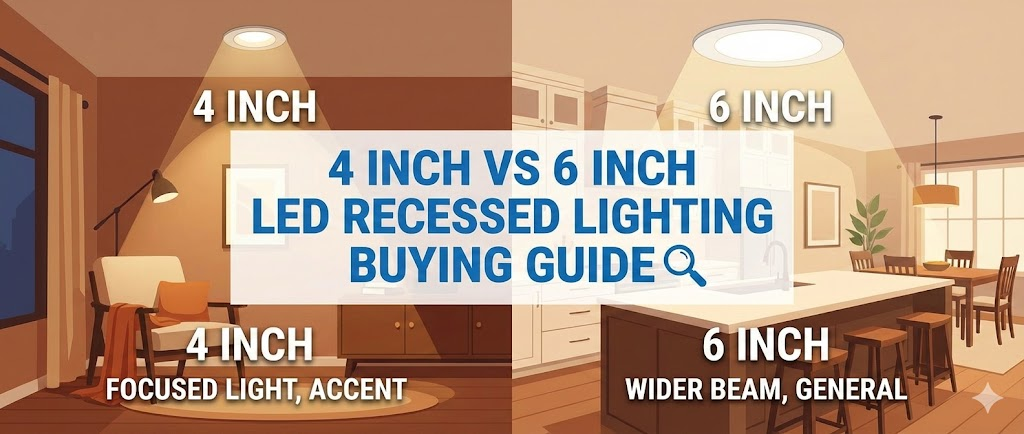
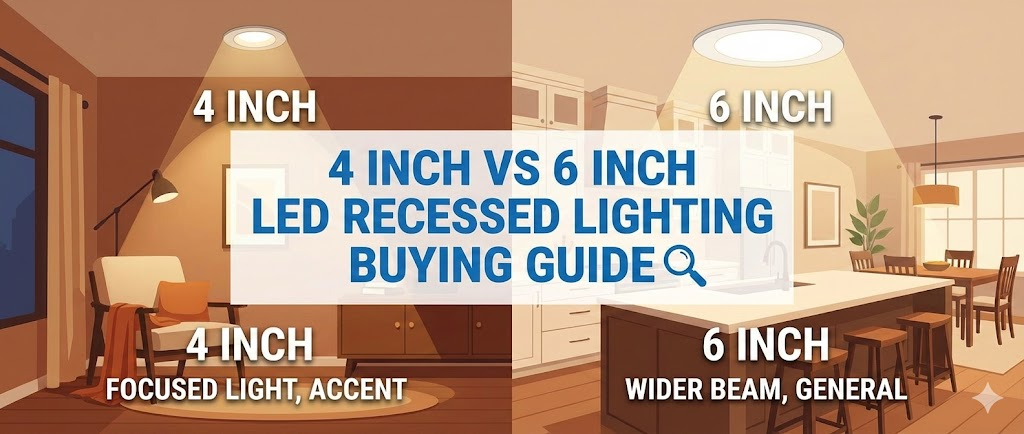
- Choose 4 inches when you want a quieter ceiling look, better control over where light lands, or when you are working with smaller rooms and tighter layouts.
- Choose a 6-inch option when you want broad general coverage, fewer fixtures in larger spaces, or a more traditional recessed look.
- If you are stuck, decide whether recessed lights are your main lighting layer or a supporting layer.
To view the main categories while planning, start with recessed lighting options here.
What is LED recessed lighting, and why does size matter
LED recessed lighting is a ceiling-mounted light that sits flush or nearly flush, sending light downward into the room without a hanging fixture. It is popular because it works in almost any style of home and can provide everything from bright task lighting to soft, dimmed evening light.
Size matters for three reasons.
First, it changes the ceiling’s visual footprint. Smaller trims blend in more. Larger trims stand out more.
Second, it changes how most people space fixtures. Spacing affects whether light feels smooth or spotty.
Third, it changes how the room “reads.” The same room can feel calm and balanced with the correct layout, or harsh and busy with the wrong one. That is the heart of how to choose the right recessed lighting size in a way that will make you happy long after installation.
What do 4-inch and 6-inch recessed lights actually refer to
Does the number describe the trim size, cutout, or the light output
Most of the time, '4-inch' and '6-inch' refer to the approximate trim size you see from below. The cutout required for the ceiling can vary depending on the product. Light output is a separate specification entirely.
How does size affect beam spread and coverage
Without getting overly technical, here is the practical relationship.
A 4-inch fixture is often used when you want more control and more flexible placement. People choose it for layered lighting plans and for tighter spaces where an extensive trim looks out of proportion.
A 6-inch fixture is often used when you want fewer cutouts and broad coverage in bigger rooms. It can be a simpler layout choice when recessed lights are doing most of the work.
This is also where many people ask, 'What’s the difference between 4" and 6 "LED recessed lighting?' The difference you notice most is how the ceiling looks and how the room fills with light based on typical spacing and placement.
When does 4-inch LED recessed lighting make more sense
Is 4 4-inch better for modern ceilings and a cleaner look
In many homes, yes. A smaller trim tends to feel more current and less attention-grabbing, especially when you have several fixtures in one room. It also plays nicely with layered lighting, where recessed lights support pendants, lamps, and wall fixtures rather than replacing them.
If you are shopping by size, you can refer to the 4-inch downlight options here.
Where does 4 4-inch work best in real rooms
If you search for four vs 6-inch recessed lighting for living room/bedroom/kitchen, you are really asking where each size “fits” in real life.
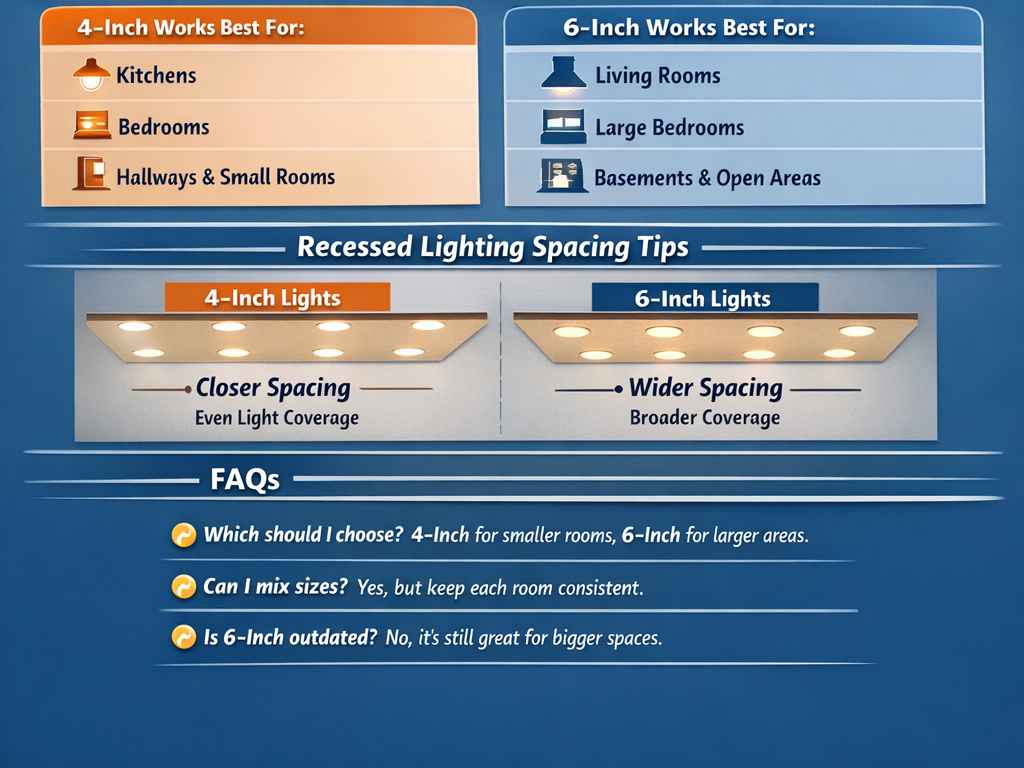
Kitchens often benefit from 4-inch lights because their placement is crucial around cabinets, sinks, islands, and prep zones. Bedrooms often benefit from a smaller trim, as it can feel calmer on the ceiling and still provide plenty of light when spaced well. Hallways and smaller rooms are another strong fit because 4-inch trims look proportional and keep ceilings from feeling crowded.
In living rooms, a 4-inch recessed lighting is a solid choice when it serves as a supporting layer, and you rely on lamps or other fixtures for most of your evening ambiance.
What trade-offs come with 4-inch lights
The main trade-off is that you may need more fixtures to get the same “even coverage” feeling in larger rooms. That is not always a downside, because more fixtures can also mean smoother light and better control when dimming. But it does affect the budget and installation time.
Another trade-off is layout sensitivity. If your spacing is uneven or your lights are not aligned with room zones, the pattern can look off more quickly.
When does 6-inch LED recessed lighting make more sense
Is 6 6-inch better for general lighting and fewer fixtures
Often, yes. If your goal is broad general lighting with fewer cutouts, a 6-inch can be a practical pick. It is commonly used where recessed lighting is intended to enhance the room, especially in larger spaces.
If you are shopping by size, you can refer to the 6-inch downlight options here.
Where does 6 6-inch work best in real rooms
6-inch lights often make sense in larger living rooms, open-concept spaces, basements, and bonus rooms, where you want fewer fixtures but still want the room to feel evenly lit. They can also work well in larger bedrooms where a simple layout and good general coverage are desired.
In kitchens, a 6-inch can still work well in bigger layouts, but placement becomes critical near counters and cabinets. If the lights are too far from the work area, shadows become a problem, and that can make the kitchen feel dim even when the room is “bright.”
What trade-offs come with 6-inch lights
The most significant trade-off is scale. In small rooms or narrow hallways, a 6-inch trim can look oversized. The second trade-off is glare risk. If a larger downlight is placed in a common sightline, it can feel harsher, especially over seating areas or near a TV wall.
This is why choosing the best LED recessed lights, specifically 4″ vs 6″, is not just a matter of size. It is also a placement and comfort decision.
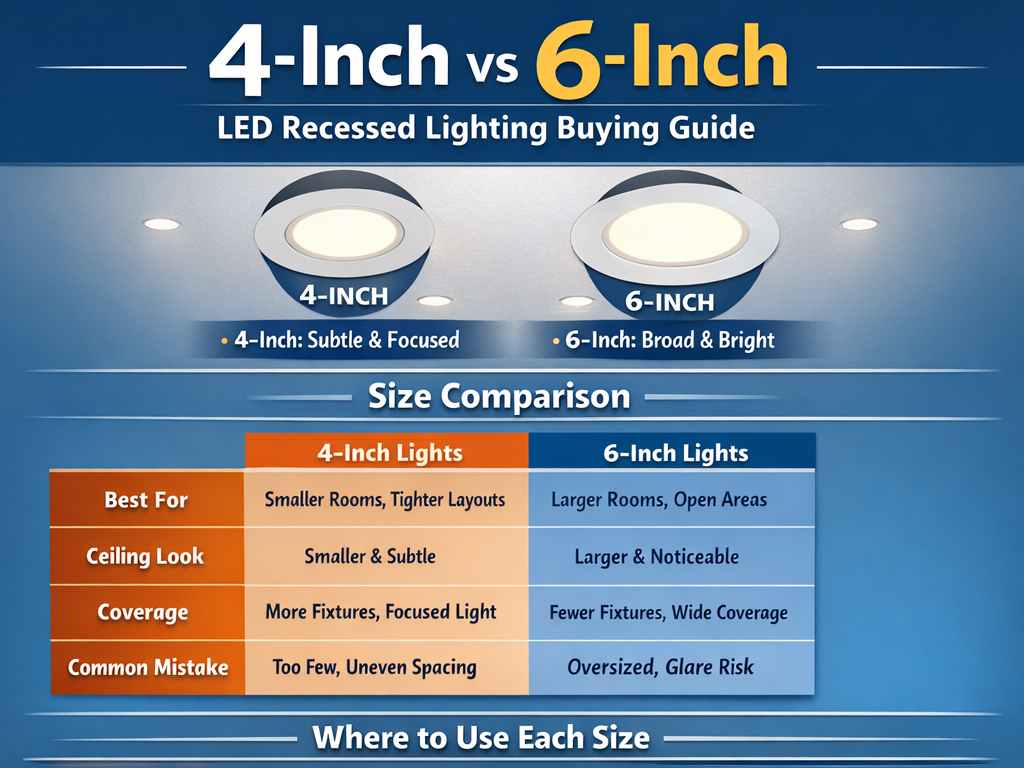
4-inch vs 6-inch LED recessed lighting side by side
LED recessed lighting size comparison table
Here is a simple LED recessed lighting size comparison to use when planning.
|
Factor |
4-inch recessed lights |
6-inch recessed lights |
|
Best fit |
Smaller rooms, tighter layouts, layered lighting plans |
Larger rooms, open areas, and general lighting plans |
|
Ceiling look |
Smaller footprint, more subtle |
Larger footprint, more noticeable |
|
Coverage feel |
More controlled, often more fixtures |
Broad coverage, often fewer fixtures |
|
Typical spacing approach |
Usually, closer spacing for smooth coverage |
Often wider spacing, but placement still matters |
|
When it shines |
Kitchens, bedrooms, hallways, accent zones |
Living rooms, basements, large bedrooms, open plans |
|
Common mistakes |
Too few fixtures, uneven spacing |
Oversized look in small rooms, glare in key sightlines |
How do I choose between 4-inch and 6-inch recessed lighting for my room
What room are you lighting
Start with function, not just square footage.
Kitchen
If you want precise lighting over prep zones and counters, a 4-inch fixture is often easier to place cleanly. If the kitchen is prominent and recessed lights are the main layer, 6 6-inch can still work well with a careful layout.
Living room
If recessed lighting is your primary source of brightness and the room is large, 6 6-inch can be a simpler plan. If you want a cleaner ceiling look and use lamps for mood, a 4-inch fixture often fits better.
Bedroom
If you want a calm ceiling look and flexible placement, 4 4-inch often feels more comfortable. If the bedroom is large and you want fewer fixtures, 6 6-inch can work well, especially with smooth dimming.
How high is your ceiling, and what mood do you want
Ceiling height changes how light spreads and how intense it feels. In taller rooms, 6-inch layouts help prevent the need for excessive fixtures. In lower rooms, 4-inch trims can feel less dominant and more controlled.
Mood matters too. If you want cozy lighting at night, plan for dimming and avoid placing lights directly in your main sightlines. That comfort step issues as much as size.
Do you want general lighting, task lighting, or both
If recessed lights are your primary lighting layer, a 6-inch fixture is often a practical choice in larger rooms. If you want recessed lights as a supporting layer, a 4-inch diameter often gives you better control and a quieter ceiling pattern.
This is the real-world version of an LED recessed lighting size guide. Match the size to the job you need the lights to do.
When should you consider specialty downlights instead
Sometimes the best result comes from a specialty design rather than forcing a standard downlight into every situation. Showers, sloped ceilings, wall washing, and other challenging areas can benefit from fixtures designed for those specific needs.
What spacing should you use for 4-inch vs 6-inch recessed lights
What is a simple spacing rule you can start with
Think in terms of overlap. You want pools of light to overlap slightly so the floor and walls feel evenly lit rather than bright in spots and dim in between.
A practical approach is to map your room zones first, then place lights to cover those zones. If you start with where you cook, read, sit, or work, spacing becomes easier to judge.
In many layouts, 4-inch fixtures are positioned slightly closer together to maintain a smooth appearance. 6-inch fixtures often allow wider spacing, but the plan still has to fit the room and the furniture.
How do you avoid shadows, glare, and spotlight rows
Shadows typically occur when a light source is positioned behind you relative to your task area. Kitchens and desks are common examples. If the light is behind you, your body blocks it, and the work surface looks dim even when the room seems bright.
Glare occurs when lights are placed in common sightlines, such as over a couch facing a TV or directly where your eyes naturally fall when you enter the room. Shifting fixtures slightly can reduce glare more effectively than changing their sizes.
Spotlight rows happen when lights are placed in a straight line without considering what they are meant to light. Align lights with zones, not just the room perimeter.
What should you check before you buy
Which trim style, color temperature, and dimming matter most
Trim style affects the visibility of the fixtures on the ceiling. Color temperature affects the overall ambiance of the room. Dimming affects whether the lighting is comfortable at night.
If you want one practical priority, choose smooth dimming and a color temperature that matches the room’s finishes and the desired mood. Bright, harsh light can make a room feel uncomfortable, regardless of its size.
Canless vs can housing and what that means for your ceiling
Many LED recessed lights are canless, meaning you do not need a traditional housing. That can make installation more straightforward, especially in remodels, but it also means you must confirm cutout size and clearance before cutting.
Whether you choose a 4-inch or 6-inch model, always check the exact specifications for the model you are buying. That one step prevents most installation regrets.
Installation tips that prevent regrets later
What to measure before cutting any holes
- Confirm the joist locations and obstacles above the ceiling to ensure your layout is feasible.
- Mark furniture zones first, then place lights where light is needed, not only where a ceiling grid looks neat.
- Double-check the cutout size for the exact fixture you plan to install before you cut the first hole.
What to do if you are mixing 4-inch and 6-inch in the same home
Mixing sizes can look great if it follows a simple logic. Use 4 inches in smaller rooms and tighter spaces where you want a quieter ceiling look. Use 6-inch fixtures in larger open areas where you want broad, general lighting with fewer fixtures.
The key is consistency inside a room. Avoid mixing sizes on the same ceiling plane unless there is an apparent reason, such as a separate zone with a distinct lighting scheme.
FAQs
What’s the difference between 4″ and 6″ LED recessed lighting?
The most significant difference is the ceiling footprint and the typical layout style, with 4-inch ceilings looking subtler and 6-inch ceilings often used for broader general coverage.
Should I choose 4-inch or 6-inch LED recessed lights?
Choose 4 inches for smaller rooms and more controlled placement, and choose 6 inches for larger rooms where you want broad coverage with fewer fixtures.
Is 4-inch recessed lighting enough for a kitchen?
Yes, 4 inches is often enough for a kitchen when fixtures are placed to cover work zones and are spaced for even overlap, especially around counters, sinks, and islands.
Is 6-inch recessed lighting outdated?
No, 6-inch recessed lighting is still widely used for general lighting in larger spaces, and it can look clean and current with good spacing, comfortable dimming, and a trim style that fits the ceiling.
Can I replace 6-inch lights with 4-inch lights without having to patch the drywall?
Usually not, because cutout sizes differ. You typically need an adapter or retrofit option designed to cover the larger opening if you want a smaller visible trim.
How many recessed lights are needed in a room?
It depends on room size, ceiling height, beam spread, surface colors, and whether recessed lights are the primary light source. Start with room zones and plan overlapping coverage, then adjust for comfort and dimming.
Buying recommendation and quick summary
If you want a cleaner ceiling look and more control, 4 4-inch is often the safer pick. If you wish to have broad general lighting and fewer fixtures in larger spaces, 6 6-inch is often the simpler pick. That is the practical takeaway from 4-inch vs 6-inch LED recessed lighting for most homes.
Plan the layout first, then select the size. When you know where you want light to land and how you want the room to feel at night, the right choice becomes much easier.
If you are ready to buy, start with Buy LED Online and choose a size that fits your room plan. Then, select trims, color temperature, and dimming options that match your actual living habits in the space.