

No, smart bulbs do not use more electricity than traditional LED bulbs while lighting, but they consume minimal standby power (about 0.2–0.5 watts) to stay connected to Wi-Fi or Bluetooth. This extra consumption is minimal compared to the energy savings from using energy-efficient bulbs like smart LED bulbs rather than incandescent or CFL bulbs.
As per U.S. Department of Energy, a minimum of 75% less energy get consumed by LED lights and they can function 25 times longer than incandescent bulbs. That efficiency benefit still applies to smart LEDs.
Smart light bulbs combine energy-efficient LED technology with remote control, dimming, scheduling, and voice integration features. Let’s break down smart bulb power consumption, how they work, and whether they significantly impact your electricity bill.
How Smart Bulbs Work?
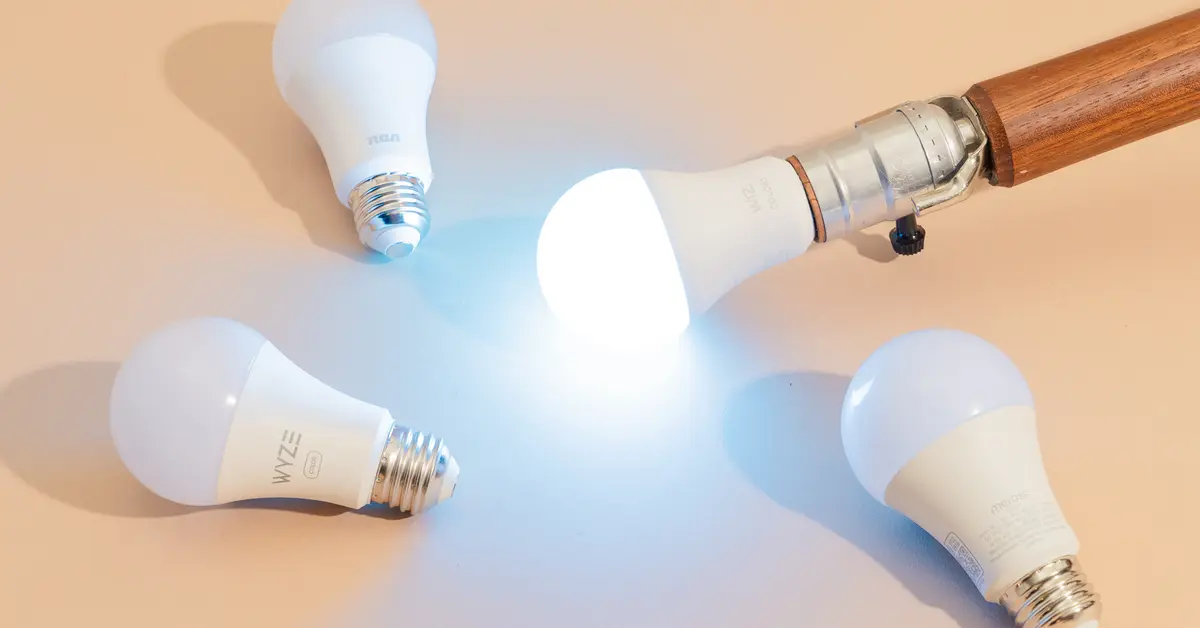
If you’re wondering, how do smart light bulbs work? They are smart LED light bulbs with built-in wireless technology such as Wi-Fi, Zigbee, or Bluetooth. This let them get controlled remotely via a smartphone app, voice assistants like Amazon Alexa or Google Assistant, or smart home hubs.
From an energy perspective-
- The LED component handles the actual lighting and consumes the bulk of electricity.
- The intelligent module (a tiny chip + radio) stays active even when the light is off so that it can receive commands.
This design introduces a small phantom load (or vampire power), but a bright bulb consumes power almost identical to a standard LED bulb of the same brightness during everyday use.
On-Mode Power Consumption Compared
Smart bulbs and regular LEDs have comparable bright bulb wattage ratings when lit.
- A standard LED bulb producing about 800 lumens typically uses 8–10 watts.
- A bright LED bulb of the same brightness also uses 8–10 watts, plus a negligible fraction for the Wi-Fi chip while lit.
In other words, if you replace a 60W incandescent bulb with a 10W bright LED, you’ll still enjoy the 80–85% savings in electricity usage comparison (LED vs. incandescent cost), regardless of the innovative features.
So, the real difference comes down to standby consumption, which we’ll cover next.
Standby (“Vampire”) Power Explained
Yes, smart bulbs use electricity when off, but only a little. This is because they must remain “listening” for a command from your phone, smart speaker, or hub.
- Most smart bulbs in standby use about 0.2 to 1 watt.
- At 0.5 watts, a bulb left in standby all year would consume around 4.4 kWh annually.
- Depending on your electricity rate (e.g., $0.15/kWh in the U.S.), that’s less than $0.70 per year per bulb.
While this standby power is real, it is tiny compared to the savings you gain by using innovative lighting efficiency features over incandescent or halogen bulbs.
Total Cost Comparison
Let’s put numbers into perspective. Suppose you have a 10W smart LED vs. a 10W regular LED bulb-
- Operating 3 hours per day
- Smart LED (on-mode)- 10W × 3h = 30 Wh/day
- Regular LED- 10W × 3h = 30 Wh/day
- Both = 11 kWh/year (~$1.65/year at $0.15/kWh)
- Adding standby (0.5W × 21h/day), the Smart LED adds 3.8 Wh/day, which is 1.4 kWh/year ($0.21/year).
So the cost to run LED smart bulbs is just a few cents more per year than a non-smart LED, showing minimal impact on home energy use.
Do Smart Bulbs Use Electricity When Turned Off?
Yes, but only a little. Even when turned off, smart light bulbs draw around 0.2–1 watt of phantom load from their Wi-Fi or Zigbee chip.
This is similar to the standby power of a TV remote sensor or a Wi-Fi router light. Over a year, the impact on your LED annual cost is negligible.
How Much Does It Cost to Run an LED Bulb 24 Hours?
If you run a 10W LED bulb nonstop for 24 hours-
- Daily- 10W × 24h = 240 Wh = 0.24 kWh/day
- Monthly- ~7.2 kWh
- Yearly- ~87.6 kWh
An average rate of $0.15/kWh is about $13 per year.
Even with continuous use, bright LED bulbs (or standard LEDs) are far cheaper to run than incandescent bulbs, which would cost over $60 for the same brightness.
Energy Saving Strategies with Smart Bulbs
The real advantage of smart home lighting isn’t just the LED efficiency—it’s the energy savings tips from advanced features.
Scheduling & Automation –intelligent light scheduling, timers, geofencing
Smart bulbs can turn on/off automatically and you can also set the schedule for that. With geofencing, they can switch off when you leave the house, cutting unnecessary usage.
Dimming & Scenes – dimming electricity savings
Dimming a bright LED saves energy because LEDs draw less power when brightness decreases. For example, running at 50% brightness may use only 4–5 watts instead of 10.
Motion & Occupancy Sensors – occupancy sensor lighting
Pairing smart bulbs with motion detectors ensures lights only stay on when someone is present, eliminating wasted “forgotten lights.”
Firmware Updates & Efficient Models – choose Energy Star bulbs
Smart bulbs from brands like Philips Hue, TP-Link, Sengled, and Wyze often release firmware updates to optimize performance. Choosing Energy Star bulbs guarantees models with verified low smart bulb standby consumption.
Broader Context- Home Electricity Usage
Lighting accounts for 10–15% of household electricity use, but with energy-efficient bulbs, this share drops significantly.
Compared to HVAC systems or refrigerators, smart bulbs' power consumption (including standby) is tiny. Yet their innovative lighting efficiency features multiply small savings into meaningful reductions across your home.
The estimated value of global smart lighting market is approximately $15.43 billion in 2023 and is expected to grow at a 21.3% CAGR through 2030 (Grand View Research), reflecting rising adoption and innovation.
Mythbusting & Future Trends
Does Dimming Always Save?
Yes. With modern smart LED light bulbs, reduced brightness means reduced wattage draw- dimming is an actual saver. Older incandescent dimming didn’t always minimize energy.
Emerging Tech – the smart lighting market
Future smart lighting market innovations include AI-driven occupancy sensing, ambient light harvesting, and eco-friendly materials. These trends will further improve smart lighting efficiency while reducing phantom load.
Conclusion & Final Verdict
So, do smart bulbs use more electricity?
Technically, but only a fraction more due to vampire power in standby mode. In real-world terms, the difference is less than a dollar per bulb per year.
Smart bulbs often save more electricity than non-smart LEDs when you factor in intelligent light scheduling, dimming, and occupancy sensors. They also add convenience, control, and sustainability to your home.
Final verdict
Smart LED bulbs are an efficient, modern lighting choice. The energy savings tips they enable outweigh the tiny standby power cost. For a wide range of energy-efficient innovative lighting solutions, you can check out buyledonline.com and find the best options for your home or office.
FAQs
Do smart bulbs increase your electricity bill?
Smart bulbs can slightly increase your bill due to smart bulb standby power, but the effect is minimal—just cents per year—automation features often lower overall usage.
How much electricity do smart bulbs use in standby?
Most smart bulbs consume 0.2–1 watt in standby mode, which equals 1–4 kWh annually—less than $1 in extra cost.
Are smart bulbs more efficient than LED bulbs?
Smart bulbs are essentially LED light bulbs with connectivity. They are equally efficient when lit but offer smart lighting efficiency through dimming, scheduling, and automation.
Can smart bulbs save money in the long run?
Yes. With occupancy sensor lighting, intelligent light scheduling, and dimming electricity savings, smart bulbs cut wasted usage. Over time, this offsets standby costs and makes them cost-effective.